
How does junk removal work in New York City? It’s not just about NYC, you describe your items, get a quote, and book a time. A junk removal crew then arrives, carries everything out, and loads a truck towards reuse, recycling, special handling, or disposal.
Where each item ends up depends on the item itself. This guide to junk removal helps you learn about the costs, process, and other things you should know. But we’ll focus on New York City rules along the way, because that’s where we provide our junk removal services.
Key Takeaways from the Junk Removal Guide
Junk removal starts with a description of your items and ends with each item taking its own route.
Condition, material, and the rules that apply decide where an item ends up.
The city collects large items at the curb.
A private company provides labor and transport from inside your home.
Some items need special handling, and many junk removal companies decline them.
Clear photos and honest access details help a company quote accurately.
How Does Junk Removal Work in New York City?
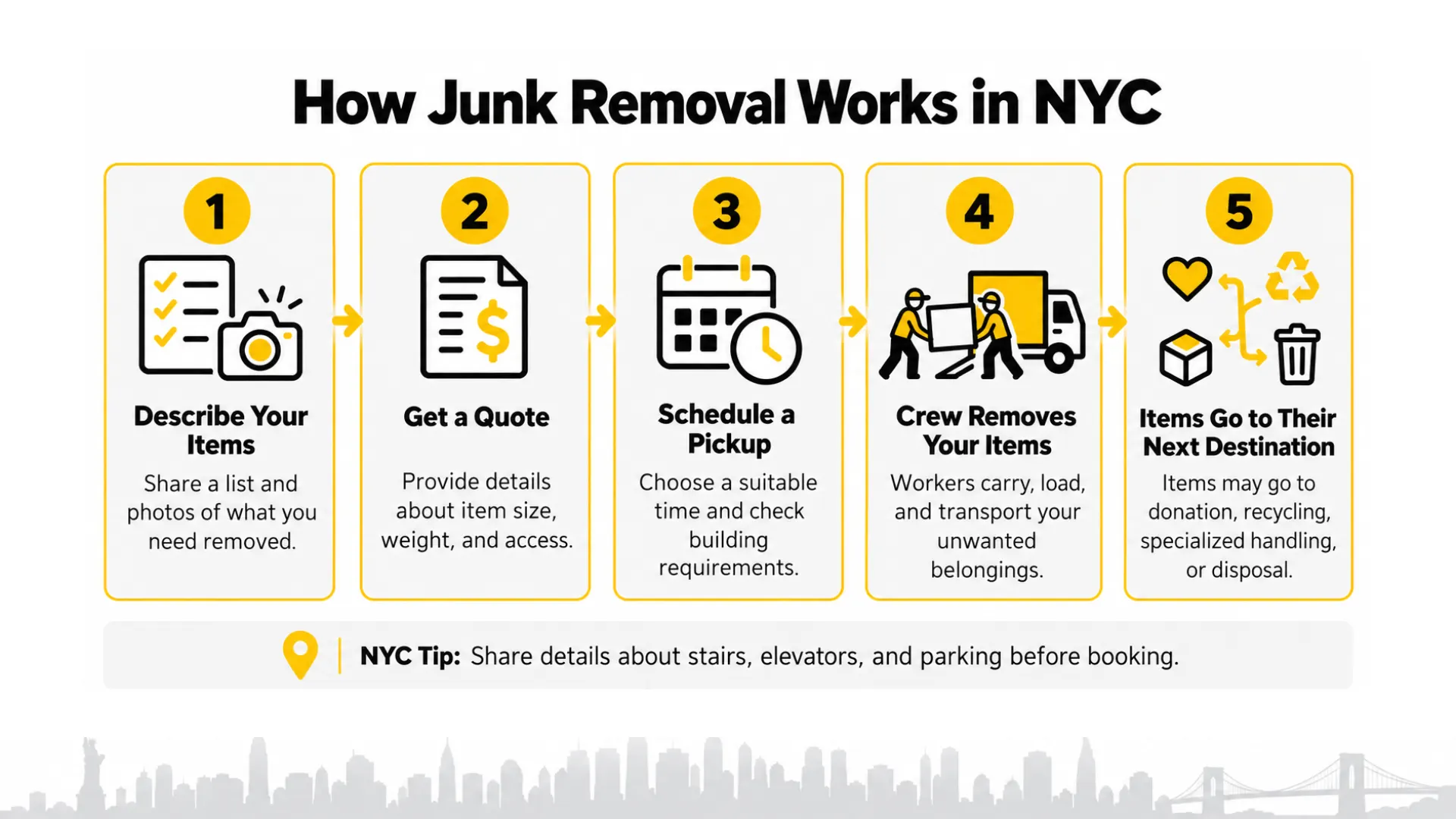
Junk removal in New York City is pretty easy and follows a clear process. First, you tell the company what you need gone, get a quote, and pick a time that works for you. Then a crew shows up, double-checks the job, carries everything out, and loads it onto their truck.
From there, they sort through the items for reuse, recycling, special handling, or disposal. Here is the full customer journey, step by step.
1. You request service.
Most companies take requests by phone, text, or online form. Give your address, the items, and where they sit in the building.
2. You describe the items.
Photos help a company judge size, weight, and material. Mention anything unusual, such as a refrigerator, a television, or a piano.
3. You receive a quote or estimate.
Some companies quote from photos, and others inspect the items first. A quote is only as accurate as the description behind it.
4. You schedule a time.
Choose a window that works with your building. Some buildings set limits on loading times or elevator use, so check with your super or management first.
5. The crew arrives and confirms the job.
The crew compares what it sees with what you described. If the load differs, a reliable company explains any price change before lifting anything.
6. The crew carries out and loads the items.
In a full-service job, you point and the crew does the lifting. Workers may disassemble furniture, wrap fragile pieces, or protect hallways.
7. The truck leaves for sorting or drop-off.
The load travels to a donation partner, a recycler, a transfer facility, or a mix of destinations. Company practices differ, so ask where your items usually go.
8. Each item follows its own route.
Reusable pieces may go to donation or resale. Metal may go to scrap recovery, and everything else needs a suitable disposal route.
Junk removal industry sources sometimes call this service junk hauling, and the crews are junk haulers. The work is the same; a crew handles the labor and transport so you do not have to.
What Happens to Junk After It is Picked Up?
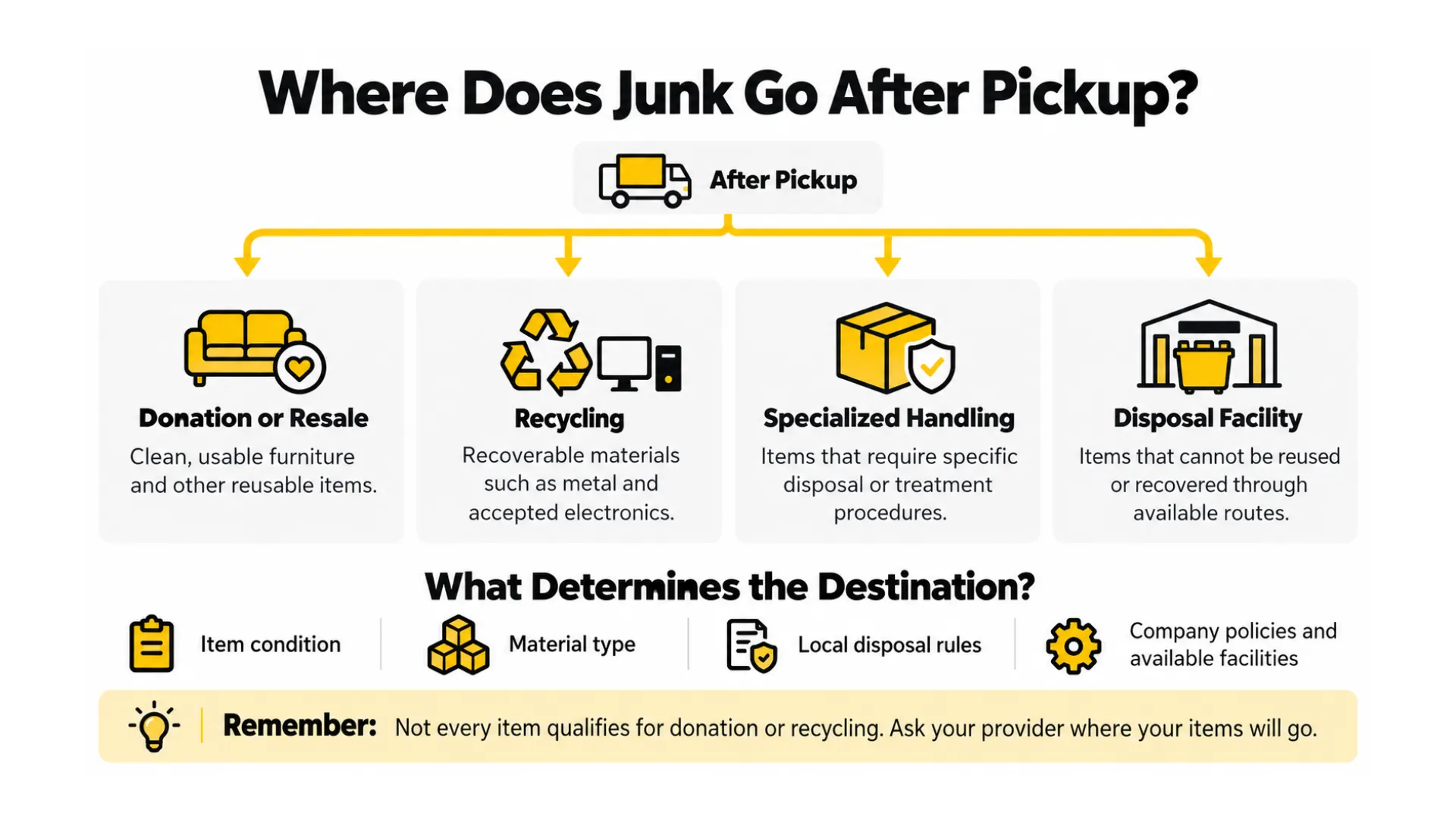
After junk is picked up by a removal service or waste management crew, it goes through a multi-step sorting and processing. Only after that, it heads to the dump.
Also, a junk removal company does not dump everything in one place. Each item follows its own path, depending on the item and company. Let us give you an example of every item as moving through one chain:
Item. What is it? A sofa, a television, and a can of paint start on different paths.
Condition. Clean, working, and sturdy pieces may qualify for donation or resale. Stained, broken, or pest-affected pieces usually do not.
Material. Metal, cardboard, and some plastics have recovery routes. Mixed or worn materials often do not.
Handling requirements. Some items need special handling, such as electronics, mattresses, and cooling appliances. Many junk removal companies restrict or decline them.
Local rules. City and state rules shape what can go where. Each company also sets its own accepted-item list.
Possible destination. Only then does an item reach donation, scrap, a specialized recycler, or a disposal facility.
You do not need to run this chain yourself. But understanding it explains why a company asks so many questions before it quotes.
Where do junk removal companies dump?
Junk removal companies do not dump everything in a single place. Instead, they sort the items they collect and send them to different destinations based on what can be reused, recycled, or must be thrown away. The same item can end up in different places.
Item | Possible route | What shapes the outcome |
Sturdy, clean furniture | Donation or resale | Condition, pests, and charity requirements |
Metal bed frame or file cabinet | Scrap or metal recycling | Material and recovery options |
Television or computer | Electronics recycling | State and city e-waste rules |
Mattress or box spring | Separate handling | Sealing, condition, and local requirements |
Refrigerator or air conditioner | Refrigerant removal, then recycling | Refrigerant type and trained handling |
Worn sofa or broken desk | Disposal | Condition and lack of reuse options |
Paint, solvents, pesticides | Special waste route | Hazardous status, and many junk companies decline them |
Private junk removal companies use their own facilities, so ask yours where items go. Be cautious with broad "eco-friendly" promises. A trustworthy company can describe what it donates, what it recycles, and what it discards. That’s just it!
Why Do Junk Removal Jobs Take Different Amounts of Time and Cost Different Amounts?
Two jobs that look alike can be different in labor, time, and cost. That means a sofa on a street-level porch is a different job from the same sofa on a fifth-floor walk-up.
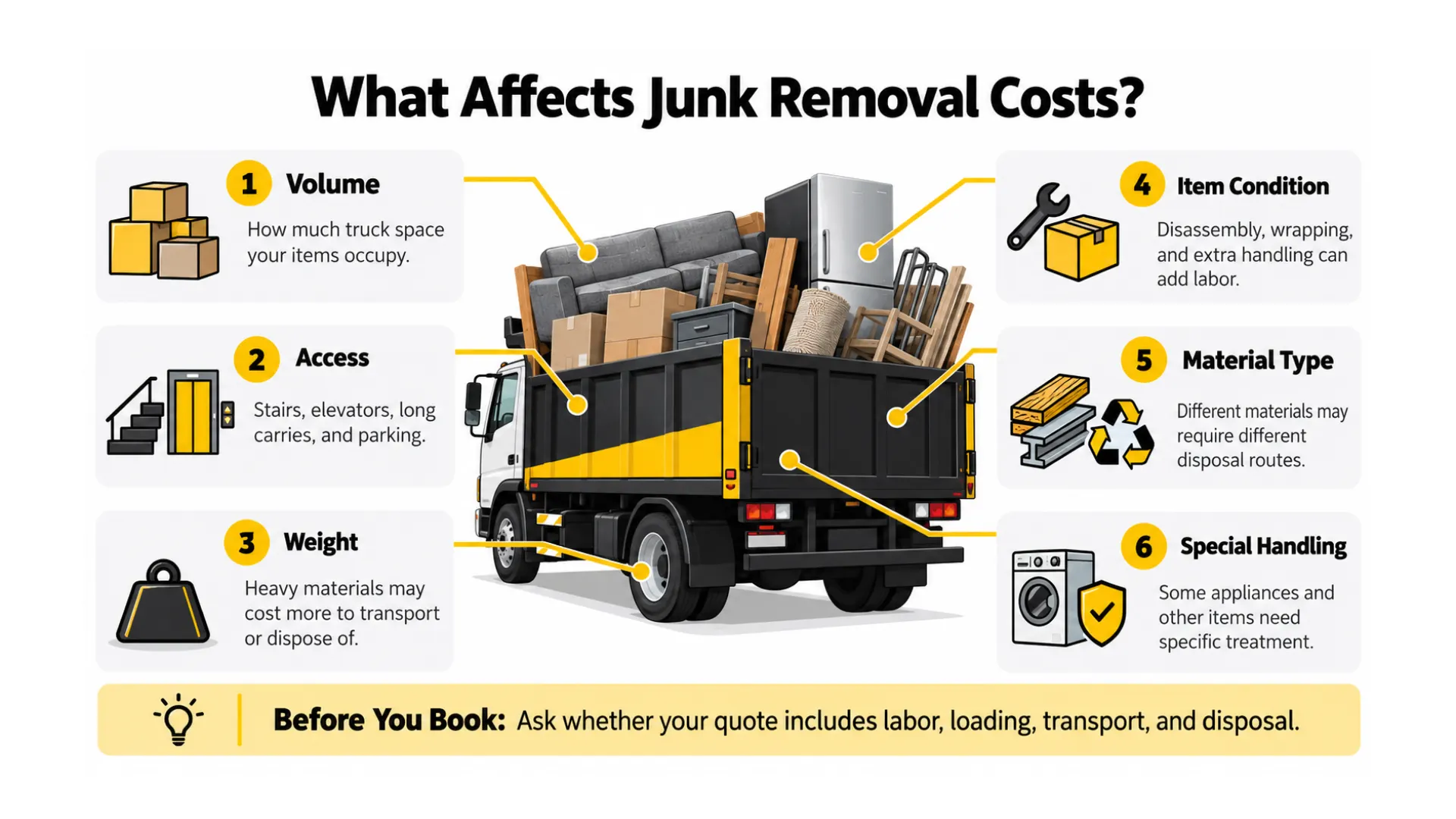
These factors explain most of the difference:
Access: Stairs, long carries, elevators, and parking set the pace. In dense NYC buildings, access often matters as much as volume.
Volume: The share of a truck your items fill, or the number of truckloads.
Weight: Heavy materials, such as concrete or tile, can cost more to dispose of.
Condition: Items that need disassembly or careful wrapping take longer. Items that fall apart add sorting.
Material: Metal, wood, and electronics each need a different route.
Handling: A cooling appliance needs refrigerant removal before recycling. A sofa does not.
A good company always asks for photos and details instead of quoting from a single word like sofa, chair or anything you want to remove.
How Does Junk Removal Pricing Work?
Junk removal pricing varies by company, but it usually ranges from a minimum base fee of $75 to $150 for small loads up to $600 to $800+ for a full truckload. Some charge by the space your items fill in the truck, and others charge per item, by weight, or by labor time.
Whatever the method, the factors above shape the final number. Treat any single price you see online as one company's method, not an industry rule.
Common junk removal pricing models
Volume-based: The price follows the share of a truck your items fill.
Item-based: Each item carries a set price, which suits small jobs.
Weight-based: The price follows how much the load weighs.
Time-and-crew-based: Larger or slower jobs may reflect labor hours.
We are not quoting a New York City price range, because no single figure fits every job. A written quote from your chosen company is the only number that counts. Ask these questions before you accept a quote:
Does the price include labor, loading, transport, and disposal?
How does the company handle a load that differs from my description?
Are there extra fees for stairs, heavy items, or special materials?
Is the price final, or an estimate pending an on-site check?
Why Pay for Junk Removal if NYC Collects Bulk Items for Free?
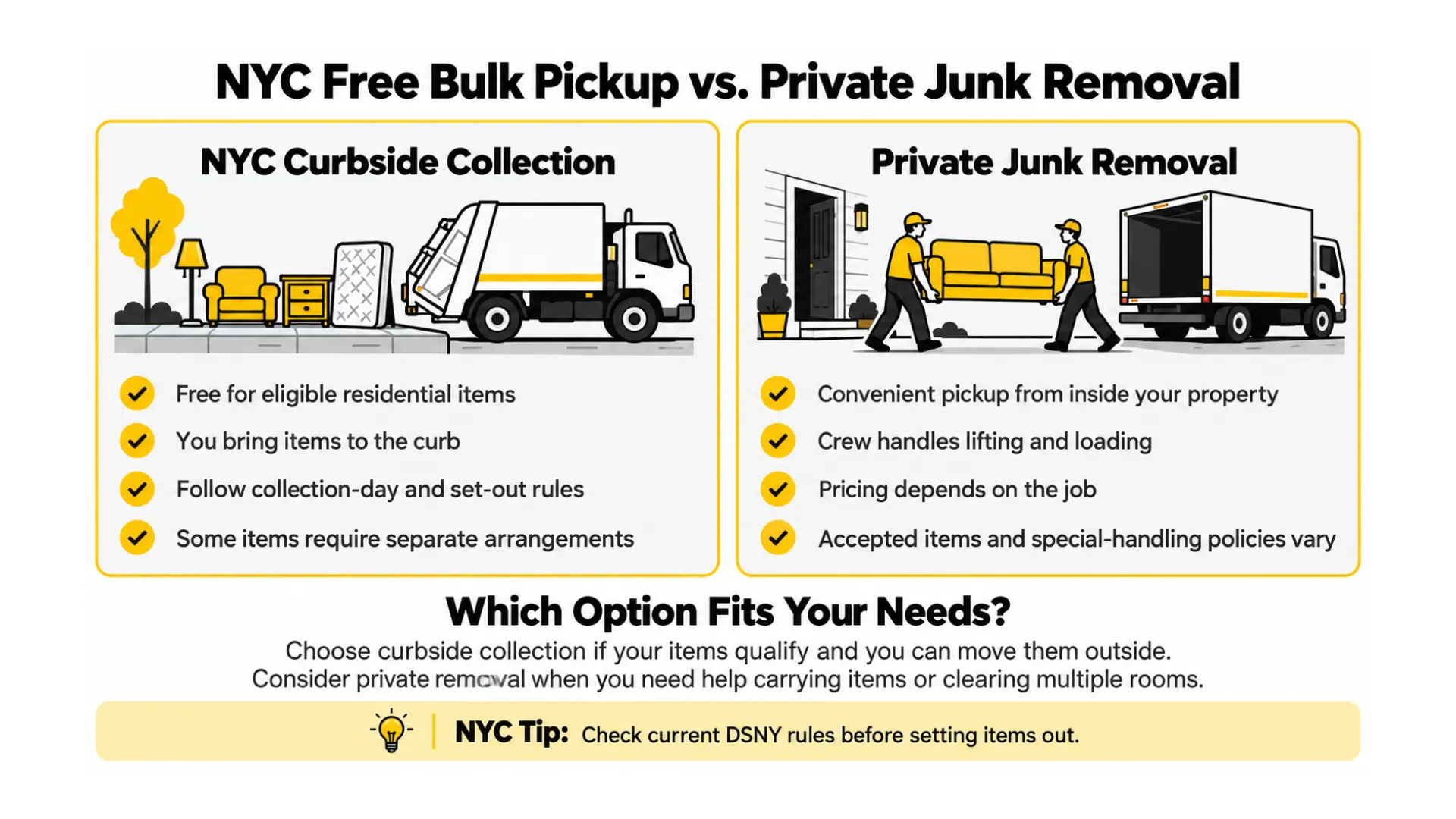
New York City collects large items from the curb under its own rules. A private junk removal company provides labor and transport from wherever your items are. That difference explains why people pay for private service.
For a few qualifying items, the free route works well. But the right choice depends on your items, your building, and your schedule.
According to DSNY, residents can set out up to six large items at the curb per collection day. Metal and rigid plastic items go out with recycling. Other non-recyclable large items go out with trash, on your trash-only day.
The city notes that pick-up appointments are no longer offered. These details can complicate the free route:
You carry every item down to the curb yourself.
Items must follow the set-out rules for your collection day.
Mattresses must be sealed in plastic.
Cooling appliances need a separate refrigerant-removal appointment.
Electronics cannot go out with regular trash or recycling.
A full-service junk removal company removes items from inside your home. It still follows its own accepted-item policy, so confirm what it takes. Private removal is not always the best option. With two or three qualifying items and time to wait, the free route can make sense.
A quick NYC junk removal decision guide
Your situation | Possible option |
A few qualifying large items, and you can carry them out | NYC curbside bulk collection may work |
Items sit inside an apartment, upstairs, or in a basement | Private full-service removal may be more convenient |
A full cleanout with many items | Private junk removal may be more practical |
Televisions, computers, or other electronics | Use an NYC e-waste route, or confirm the company accepts them |
Refrigerator, freezer, or air conditioner | Schedule NYC appliance removal, or ask a company if it accepts them |
Paint, pesticides, or other hazardous household products | Use an NYC special waste route, since many companies decline these |
Renovation or contractor-generated debris | Different disposal rules may apply |
Anything you are unsure about | Confirm the correct route before setting it out |
What NYC rules say about special items
Mattresses and box springs.
New York City requires them to be sealed in plastic bags and set out on your trash-only day. If you skip special disposal rules, DSNY may refuse collection and fine you.
Cooling appliances.
DSNY requires an appointment to dispose of appliances containing CFC (chlorofluorocarbon) gas. That includes refrigerators, air conditioners, and water coolers. Specially trained DSNY staff remove the gas first.
The free service is for residents only. DSNY also says it cannot collect some newer appliances that contain R600a or R32 refrigerants. Look for the warning sticker, a yellow triangle with black flames. For those appliances, contact the manufacturer or a private carter.
Electronics.
Under a New York State law, certain electronics can no longer be collected with trash or recycling. The examples include televisions and computers.
Household hazardous products.
Items like pesticides and strong cleaners use the city's special waste route. DSNY runs a Special Waste Drop-Off Site in each borough and seasonal SAFE Disposal Events. But both serve residents only.
Construction and renovation debris.
DSNY offers free curbside removal for materials from small do-it-yourself projects done without hired workers or contractors. The six-item limit applies.
According to DSNY, construction and demolition waste from professional contractors cannot be discarded as residential garbage. The contractor or resident must arrange for a dumpster through a private trash removal service.
What Does a Full-Service Junk Removal Company Do?
When you hire a full-service junk removal company, you pay mostly for labor. The crew does the work, the city expects you to do yourself. There are some inclusions and exclusions, so confirm each one before booking.
Lifting and carrying: The crew takes items from where they sit, including basements, closets, and upper floors.
Stairs and elevators: Workers move items through walk-up stairwells, halls, and freight elevators.
Disassembly: Workers take apart beds, tables, and sectionals that will not fit through doors.
Loading: The crew packs and secures the truck.
Transport: The truck takes the load to its destinations.
Sorting: Items go toward donation, recycling, or disposal, based on the company's accepted list.
Cleanup: Some companies sweep the pickup area and protect floors and walls.
Post-project cleanup is often where junk removal companies differ the most. When getting a quote, always ask if the final price covers floor protection and sweeping up remaining debris.
What Items Can Junk Removal Companies Take?
Most junk removal companies take bulky household items, furniture, and general clutter. Acceptance varies by company, material, and local rules. Check the provider's accepted-item list before you book instead of assuming a pickup will cover everything.
These are some common item categories:
Furniture: Couches, tables, dressers, desks, and chairs
Appliances: Washers, dryers, stoves, and dishwashers
Mattresses and box springs: Often accepted, but handling can vary
Household clutter: Boxes, bags, and unwanted belongings
Office items: Desks, cubicle panels, filing cabinets, and chairs
Electronics: Accepted only where the provider has a compliant recycling route
Outdoor items: Patio furniture, grills, and planters
Renovation debris: Accepted by some companies, depending on material and project
Some items require special handling, and many junk removal companies either restrict or decline them:
Paint, solvents, and pesticides
Fuel, oil, and other flammable liquids
Asbestos-containing materials
Pressurized containers
Batteries and lamps with hazardous components
Do not move or mix hazardous products yourself. If a label shows a warning, follow the official New York City guidance instead.
How Does Junk Removal Work for Different Types of Jobs?
The core process stays the same for every job. What changes is access, sorting, and timing.
Single-item removal:
One item, such as a couch, needs a quick appointment. Stairs and doorways matter more than volume. Ask whether the crew can disassemble it.
Apartment and house cleanouts:
Many rooms mean more sorting and more trips. In apartments, hallways, elevators, and building rules set the schedule. In houses, basements and attics add labor.
Move-out and estate cleanouts:
Move-outs run on a deadline, so confirm the arrival window early. Estate cleanouts add sentimental items, documents, and valuables. Sort these before the crew arrives.
Office, commercial, and renovation debris:
Desks, electronics, and files may follow different disposal rules. For renovation debris, the material type and who generated it decide the allowed route.
Across New York City's five boroughs, your building type is the biggest factor in how hard and expensive a junk removal job will be.
For example, clearing out a Staten Island house with a private driveway is easy and thus affordable. It’s because workers can back the truck right up to the door.
On the other hand, a Manhattan walk-up apartment requires hauling heavy items down narrow and steep stairs with no parking nearby. It can be quite challenging and thus expensive.
How Should You Prepare for Junk Removal?
The best preparation is information, not heavy lifting. Tell the company what you have, where it sits, and how the crew can reach it. Good details let a company quote accurately and avoid delays on the day.
Use this checklist before the crew arrives:
Mark items you are keeping, and keep valuables and personal documents apart.
Include wide shots and close-ups of large items, along with anything unusual.
Mention electronics, appliances, paint, chemicals, and renovation debris up front.
Tell if items are inside, outside, upstairs, in a basement, or behind a locked area.
Give the number of flights, and say whether a freight elevator is available.
Tell the company where a truck can stop, and for how long.
Ask what the price includes, and how the company handles differences in the load.
Move small obstacles so the crew can work safely and quickly.
Ask building management about loading windows, elevator reservations, or insurance requirements.
Heavy items and sharp materials can cause injuries to you, your staff, or your kids. Let the crew handle lifting, and do not try to dismantle appliances yourself.
How Long Does Junk Removal Take?
Junk removal time depends on the size and complexity of the job. A small pickup may take far less time than a full cleanout. That’s why no universal duration applies, so ask the company for an expected window.
The same factors that shape price shape time: access, volume, weight, disassembly, and special handling. Crew size and parking also matter. In New York City, getting items from the unit to the truck often takes longer than the loading itself.
Frequently Asked Questions
We’ve already answered the most important questions. But read on for quicker answers.
Junk Removal is Simple if You Know a Few Things
Junk removal looks simple from the curb, but each item follows its own route. Knowing that helps you give better details, compare quotes fairly, and avoid surprises on pickup day.
For a few qualifying items, the city's free curbside service may be enough. For items inside your home or a full cleanout, private junk removal saves real effort. For special items, confirm the company accepts them first.
Written by
NYC Junk Removal
October 14, 2026 · 5 min read